|
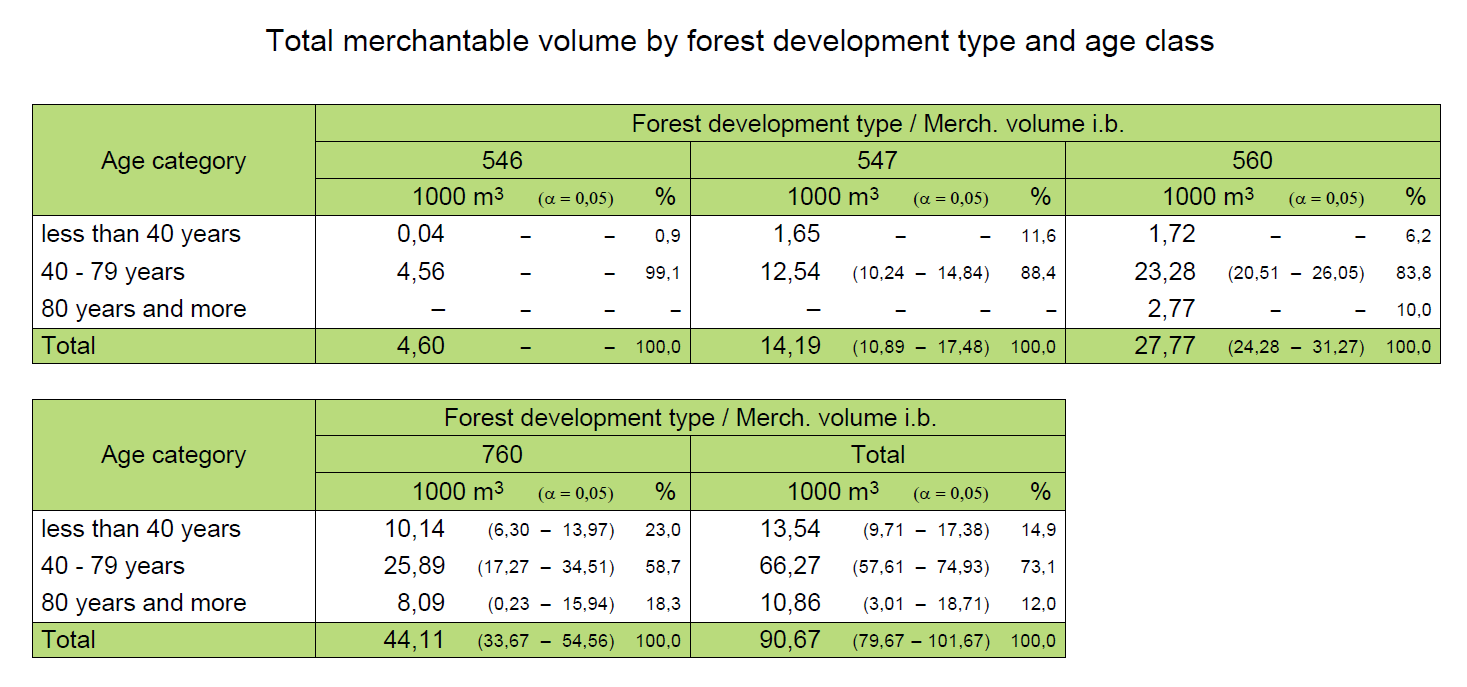
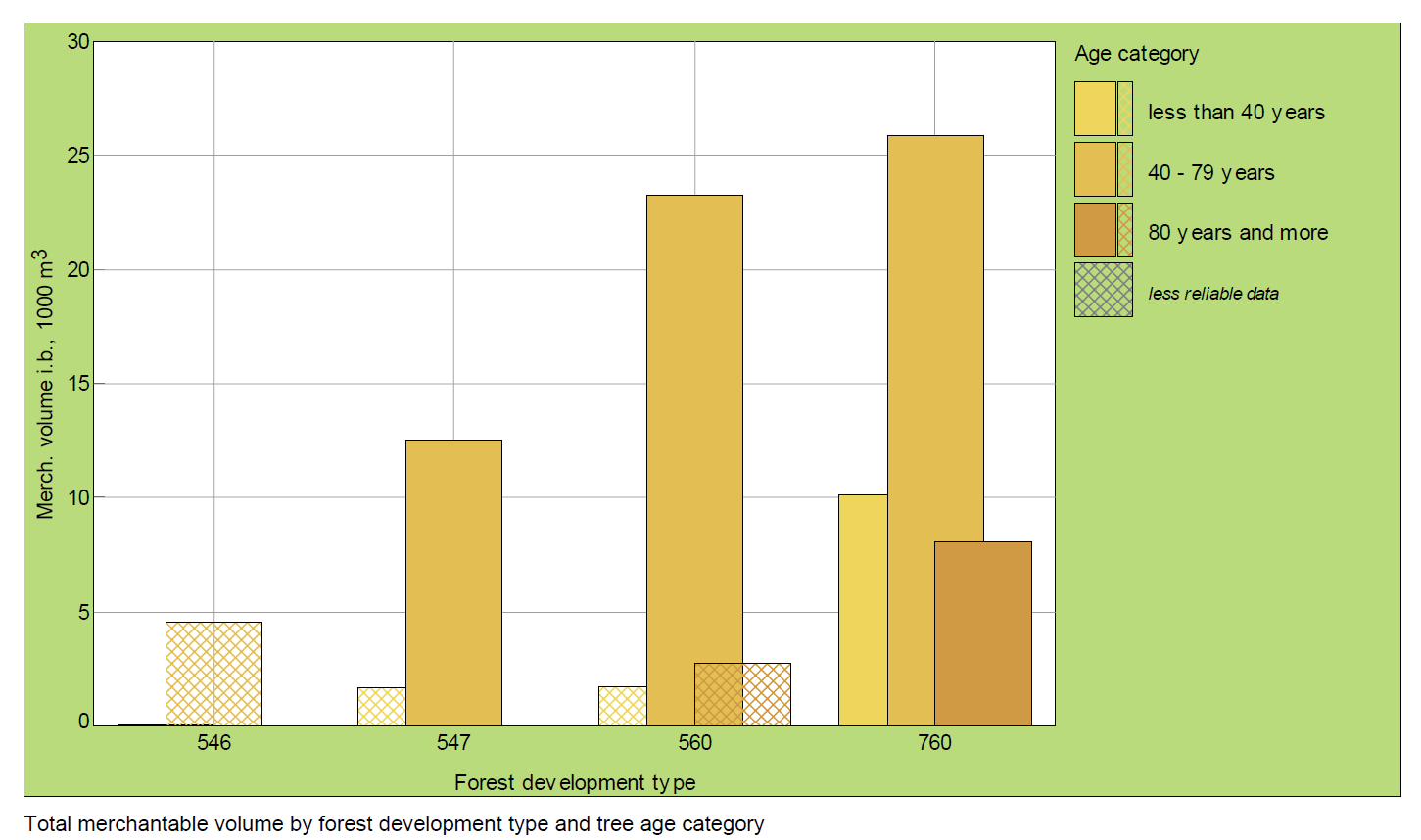
Result of this task shows distribution of the total merchantable volume i.b. among different types of forest and defined age classes (40 years interval).
Requirements:
For that task is necessary to run the stratification by forest development types (see Stratification), to set the plot area to be 500 m2 (see Set plot/subplot area action), to classify trees among 40 years age classes (see Classification) and to calculate merchantable volume i.b. per each single tree (see Calculate tree biomass (volume) action).
Procedure:
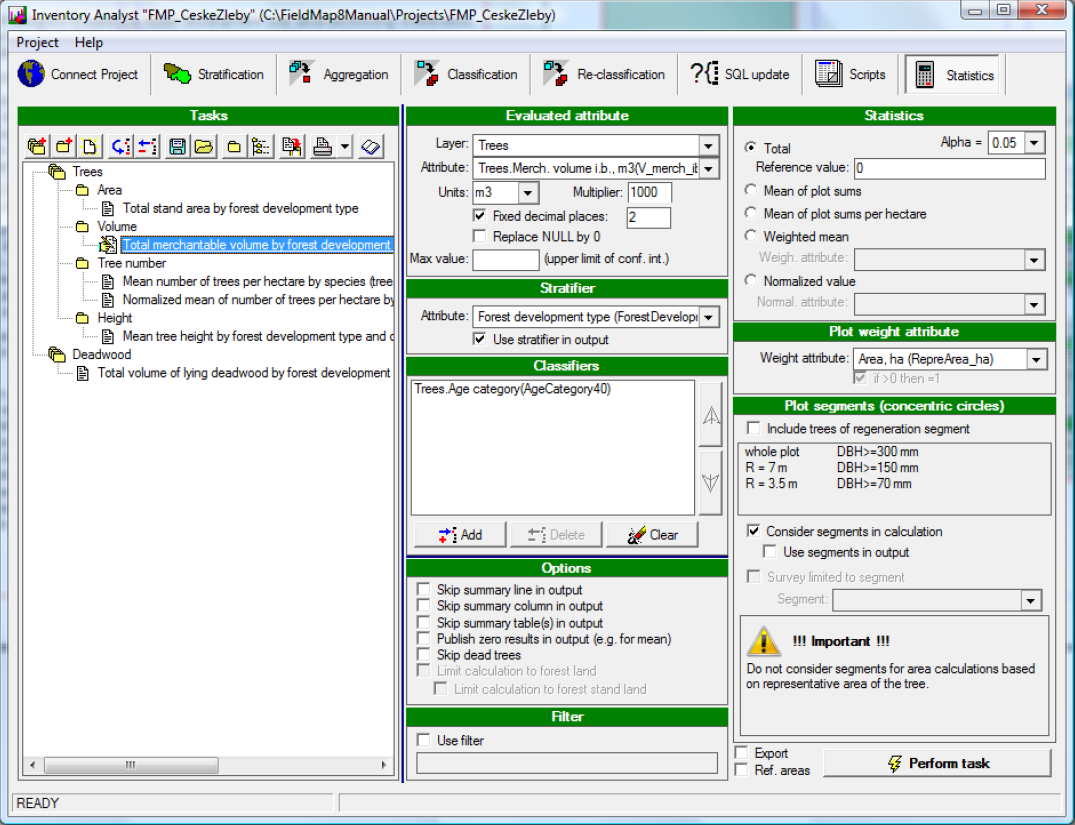
- Add new task and rename it.
- Select “Trees” layer.
- Select “Trees.Merch. volume i.b. m3 (V_merch_ib_m3)” attribute.
- Set “m3” in the Units combo box, multiplier to 1000 and number of decimal places of your choice (e.g. 2).
- Select “Forest development type (Forest development type)” in Stratifier section and tag Use stratifier in output checkbox.
- Select “Trees.Age category (AgeCategory40)” as classifier (Note: Click Add classifier button and tag “Trees.Age category (AgeCategory40)” check box).
- Select Total and desired Alpha (e.g. 0,05) in Statistics section.
- Set “Area, ha (RepreArea_ha)” into the weight attribute.
- Run the task using Perform button.
Comments
Whole plot is assigned to particular forest development type while performing stratification. At the same time the total area of each forest development type is calculated based on existing vector map (shapefile).
Volume is expressed in m3 and multiplier is set to be 1000 to makes output more readable.
Setting attribute ForestDevelopmentType as stratifier increases precision of the output since there is available information about size of the stratums derived from the map of forest development types. We may also assume that variability within particular stratum is smaller than variability within whole population, thus calculated confidence interval is going to be smaller.
Setting age category as classifier splits and calculates output also for defined age categories (40 years step).
Total is selected and weight is set to be RepreArea_ha attribute. If any weight for total is included, the box “if > 0 than = 1” will be checked automatically. This is called virtual stratification and it excludes plots with missing weight attribute (plots without trees) from the calculation of confidence interval. In other words excluding plots without trees from calculation of total volume decreases variability within particular stratum and thus calculated confidence interval is smaller. This procedure does not affect calculation of the total itself.
Because there is not any merchantable volume in trees smaller than 7 cm of DBH (i.e. regeneration trees) including/excluding trees of regeneration segment does not affect the result.
Trees in this project were measured using concentric circle approach (see Project description section). Tagged the checkbox Consider segments in calculation ensures that trees of smaller dimensions (those from inner circles) are calculated in relation to the size of the subcircle they belong to (for details see Using concentric circles at inventory plots). In our case three separate calculations are performed. Trees between 7 and 15 cm of DBH are processed in relation to the circle of radius 3,5 m, trees between 15 and 30 cm of DBH are processed in relation to the circle of radius 7 m and finally trees above 30 cm of DBH are processed in relation to the whole plot (radius of appr. 12,62 m). Error propagation procedure is used to combine those partial results to the final result.
Screenshots
Results:
|