|
This action is used to model missing tree heights. In the field, heights are usually measured only for selected trees (e.g. sample trees); the rest of heights is modeled. Inventory Analyst models missing height using one of predefined growth models based on requirements specified by user (e.g. min. number of sample trees used for parameterization, specified stratifier).
Inventory Analyst attempts first to parameterize the model using measured heights of same species on the same inventory plot (i.e. local model). Than, if there is not enough number of samples available on the level of single inventory plot, the model based on measured heights of same species regardless location of samples is used and if this fails (there is no enough heights of particular species measured in database) the common model is used regardless species and location (i.e. general model).
Modeled height can be stored either with negative mark in Height_m attribute (only missing heights are modeled) or in the new attribute specified by user (all tree are modeled; measured trees are used only for the parameterization of the model).
Inventory Analyst creates automatically graphs for each single inventory plot to allow user review the result of modeling and also some selected statistics (e.g. graph “Measured versus modeled heights”, residuals distribution graph etc.). Calculated parameters for all inventory plots are also available.
In inventories with repeated cycles, we recommend to use exponential function H=1.3+exp(P1+P2/DBH). It is simple and robust function. Its advantage is that in repeated measurement cycle we inherit curve from previous cycle and adjust it with new measurement data. Parameter P2 remains the same and only P1 is being adjusted. Thus the nature of the model guarantees that there will be no mismatch crossing of the curves in subsequent inventory cycles.
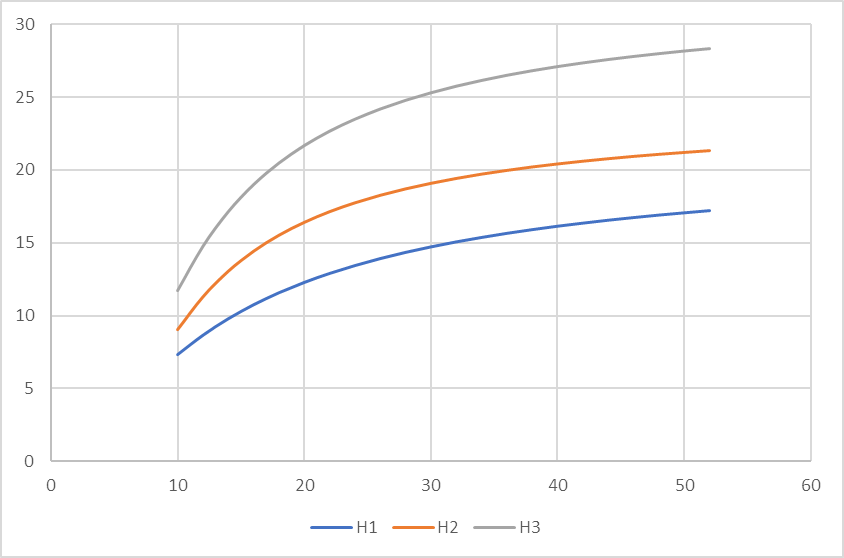
Height model parameters are saved in HeightParams.xml. This file is being used in following cycle as an input.
In the same file we also store coordinates of the trees of given category (species) within the plot. Using these coordinates FMIA checks whether same trees were measured. The plot is considered as repeatedly measured if at least 20% of trees (of given species) remains at the same coordinates. That means that there could be some ingrowth. If there is no sufficient fit in coordinates the plot is considered as new stand and new independent model is being fitted.

In model charts and HeightParams.xml you can find model type. There are few options:
|
GLOB
|
Generalized model e.g. for all plots and all species, for all plots and given species etc.
|
|
LOC
|
Local model – when at least 4 heights are measured for category (species) within plot FMIA tries to parameterize model
|
|
ADJGLOB
|
Global model adjusted by measured height(s). If there are no sufficient number of measured trees or parameterization failed then the measured heights are being used for calibration of global model.
|
|
ADJOLD
|
Adjusted old mode is being used for repeated measurement. The curve is inherited from previous measurement and adjusted by newly measured heights. If basic exponential function H=1.3+exp(P1+P2/DBH) then the parameter P1 is calibrated by new measurement.
|
|
OLD
|
The model of previous measurement is used without any adjustment
|
|
ADJOLD+P
|
Dtto ADJOLD + added point from previous measurement
|
|
OLD+P
|
Dtto OLD + added point from previous measurement
|
|